The novelty of generative AI has largely worn off for professional creators. A year ago, a flickering four-second clip of a neon cityscape was enough to garner millions of views and a flurry of “how-to” comments. Today, that same output is considered digital noise. The market has shifted from admiring the technology to demanding its utility. For those looking to build a sustainable business, the goal is no longer to generate a “cool” video, but to engineer a repeatable production pipeline that treats the AI Video Generator not as a magic wand, but as a manufacturing floor.
Monetization in this space is rarely found in the viral “one-off.” Instead, revenue lives in the bridge between high-fidelity image generation and coherent video synthesis. To cross that bridge, creators are pivoting away from erratic prompting toward industrialized workflows that prioritize consistency, modularity, and speed.
The High-Volume Fallacy in Generative Content
A common trap for new creators is the “prompt-and-pray” method—generating hundreds of clips in the hope that one will be high enough quality to use. This is the antithesis of a professional workflow. In a traditional production house, every hour spent on “experimentation” is an hour of lost margin. Generative video is no different.
The bottleneck for most creators isn’t a lack of imagination; it’s the lack of a predictable output. If you cannot guarantee that a character will look the same in shot A as they do in shot B, you cannot sell a narrative. If you cannot maintain the same lighting across three different clips, you cannot sell a brand asset.
Moving toward a manufacturing mindset means identifying where the process breaks. Usually, the break occurs at the transition from a static concept to motion. Creators who successfully monetize are those who treat the initial image as a “blueprinted” asset. They stop chasing the perfect video prompt and start perfecting the visual foundation, ensuring that the AI Video Generator has a rigid set of parameters to follow.

Architecting the Visual Foundation with Nano Banana
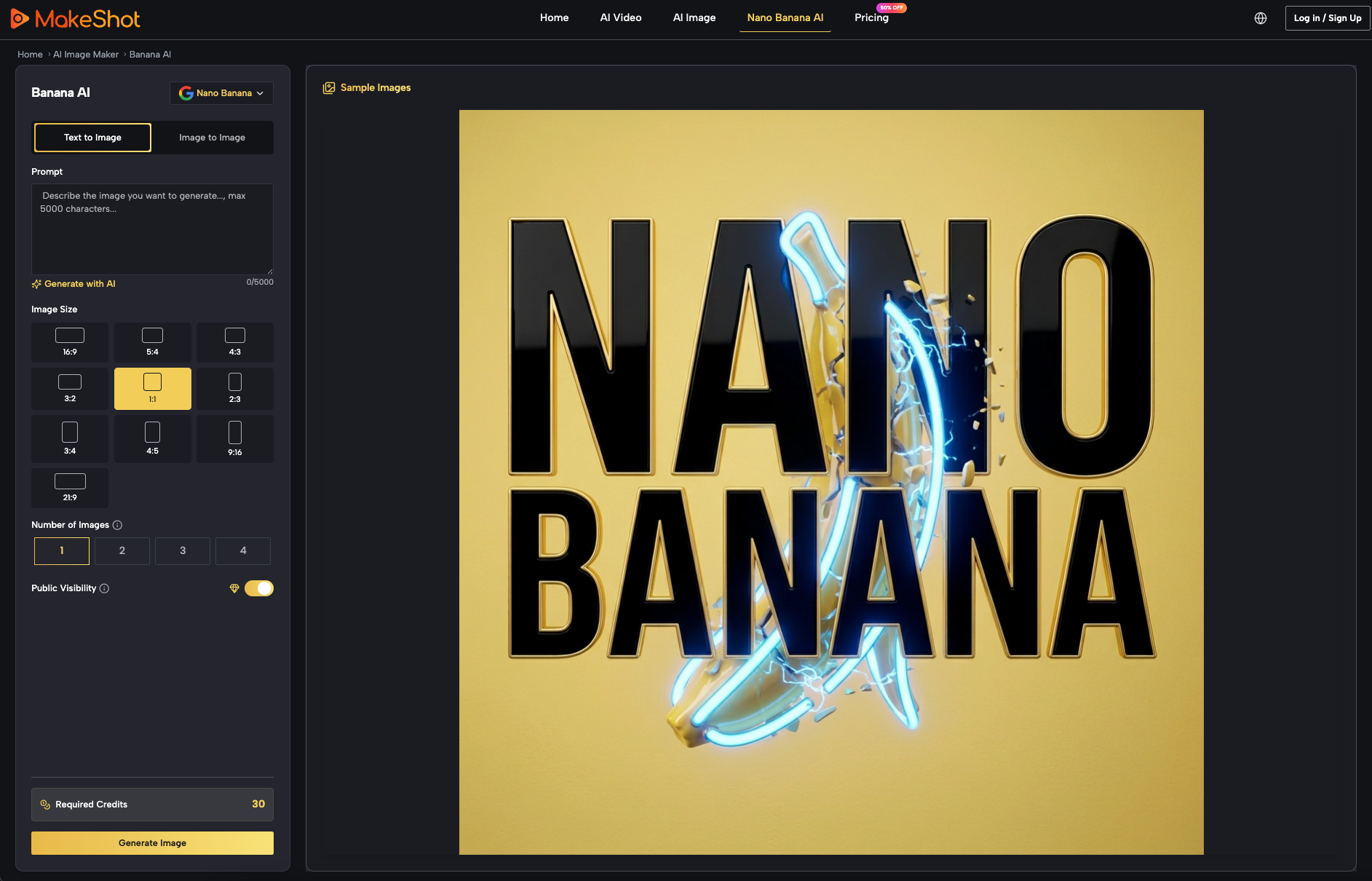
Consistency is the currency of professional media. To achieve this, many operators are utilizing Nano Banana within the MakeShot ecosystem to act as a digital art department. Before a single frame of video is rendered, the visual “bible” of the project must be established.
The tactical advantage here lies in the restyling and image-to-image capabilities. Rather than asking an AI to “create a futuristic car driving through a city,” a professional creator uses Nano Banana to generate the car first, refining the color grading, materials, and environment in a static environment. Once the “Seed” is established, they can use that image as a reference point for all subsequent frames.
This reduces “visual noise”—those jarring shifts in texture or geometry that often plague AI video. By refining the image-to-image prompts before moving to animation, you significantly lower the failure rate of the video generation phase. It is far cheaper and faster to iterate on a static image than it is to wait for a 10-second video render only to realize the protagonist’s wardrobe has changed mid-scene.
Streamlining the Motion Pipeline via AI Video Generator
Once the visual foundation is locked, the focus shifts to scaling the motion. This is where the AI Video Generator serves as the engine of the pipeline. In a high-output environment, creators aren’t just making one video; they are creating a library of modular assets.
A modular approach involves breaking a project down into reusable “b-roll” and scene templates. For instance, if you are building a faceless YouTube channel in the travel niche, you don’t generate a full five-minute video at once. You generate a series of high-fidelity 5-second clips: a plane landing, a close-up of a passport, a panoramic sunset.
By utilizing the AI Video Generator to unify different underlying models—such as Sora 2, Kling, or Google Veo—creators can select the specific “flavor” of motion that fits the scene. Some models excel at cinematic camera sweeps, while others are better at subtle character movements. A unified platform allows an operator to move between these tools without breaking the workflow, treating the various AI models like different lenses in a camera kit.
One major uncertainty in this stage is the “hit rate” of complex motion. While simple pans and zooms are now highly reliable, any prompt involving complex physical interactions—like a person tying their shoelaces or two characters shaking hands—remains a gamble. Expectation-setting is crucial here: the current state of the technology is best suited for atmospheric, environmental, and non-interactive character shots. Attempting to force complex physics often leads to “hallucinations” that render the footage unusable for commercial clients.
Monetization Tiers: Where the System Meets the Market
Once the pipeline is repeatable, the question becomes: who pays for this? We are seeing three primary tiers of monetization emerging for creators using an AI Video Generator.
Faceless Vertical Content
The most accessible tier is the “faceless” brand. Platforms like TikTok, Reels, and YouTube Shorts have an insatiable appetite for high-frequency content. Creators are building entire channels around niches like philosophy, historical reenactments, or “cozy” aesthetics. Because the production cost per second of video has dropped by 90%, these channels can remain profitable even with moderate ad-sense revenue, provided the creator has a system to push out 3-5 high-quality videos a day.
Performance Marketing and Ad Creatives
Performance marketers are perhaps the most eager buyers of generative video. In digital advertising, “creative fatigue” is a constant battle. An ad that performs well on Monday might be dead by Thursday. Brands need to test hundreds of variations of a single hook. A creator who can take a brand’s product image, run it through an AI Video Generator, and produce twenty different “lifestyle” backgrounds in a single afternoon provides immense value. This shifts the turnaround time from weeks of physical shooting to a three-hour sprint.
The AI-Plus-Editor Agency Model
Traditional brands are often hesitant to use pure AI output because it can feel “hollow.” The most lucrative path for many creators is the “AI-Plus-Editor” service. In this model, the creator uses AI to generate 80% of the footage but relies on traditional post-production—color grading, professional sound design, and tight manual editing—to give the final product a “human” soul. You aren’t selling “AI video”; you are selling a “Premium Video Production” at a price point that undercuts traditional agencies while maintaining a much higher profit margin for yourself.
Operational Limits and the Boundaries of Automation
Despite the rapid progress, the “set it and forget it” content machine does not yet exist. A significant limitation is the lack of long-form narrative coherence. An AI Video Generator can create a stunning 10-second shot, but it cannot yet “remember” what happened 60 seconds ago in a way that allows for complex, multi-scene storytelling without heavy human intervention.
There is also a persistent “uncanny valley” effect. Purely automated content often fails the viewer-retention test because it lacks intentionality. Every frame in a traditional film is there for a reason; AI-generated frames are often there because the probability of the next pixel suggested it. Creators must act as the “intentionality filter,” discarding the technically perfect but narratively empty shots.
Finally, the legal landscape remains an area of high uncertainty. While platforms like MakeShot provide the tools to create, the copyrightability of AI-generated assets is still being debated in courts worldwide. For creators, this means the long-term valuation of an AI-only library is speculative. The safest play is to use generative tools to augment original intellectual property—characters, scripts, and brand identities that you own—rather than relying on the AI to “invent” everything from scratch.
The pivot from experimentation to production is ultimately a shift in focus from the output to the *process*. The creators who will thrive in the next twenty-four months are those who treat their AI Video Generator as just one component in a larger, human-directed assembly line. Success isn’t about the prompt; it’s about the pipeline.