Two people walk into the same house on the same afternoon. The first person has a clear idea of what they want, and they’re pretty sorted. Before the entry door could close behind them, their analytical skills were in action. In their mind, questions like “Is the living room spacious enough?” and “Is the layout standard for this price range?” are being answered rapidly.
The second individual’s pace is slower, and their evaluation of the space is slower still. They take their time to sufficiently absorb the essence of the property, one calm corner at a time. Instead of rushing to label anything, they use their intuition to get a feel of the space.
Later, when asked about the house, the first person was quick to provide all the necessary figures. The latter struggled to put their thoughts into words, but once they did, it almost sounded lyrical. That’s as close as it gets to the difference between describing a home on paper and describing life inside it.
This stems from the fact that certain evaluation methods don’t take the route of logic. Extending beyond simple metrics, they can convey volumes about a home. This article will discuss three ways in which homes can be evaluated through perception and subjective experiences.
First Impression Based on Visual Instincts
Some people call it the power of first impressions, whereas others refer to the same phenomenon as the bias of first impressions. Either way, both groups acknowledge that the opinion we form of something the first time we see it does count.
Even when it comes to a home, the human mind tends to draw certain conclusions just upon seeing the structure. Logically, we may be aware of possessing limited information about the property, but that doesn’t stop the brain from relying on visual instincts.
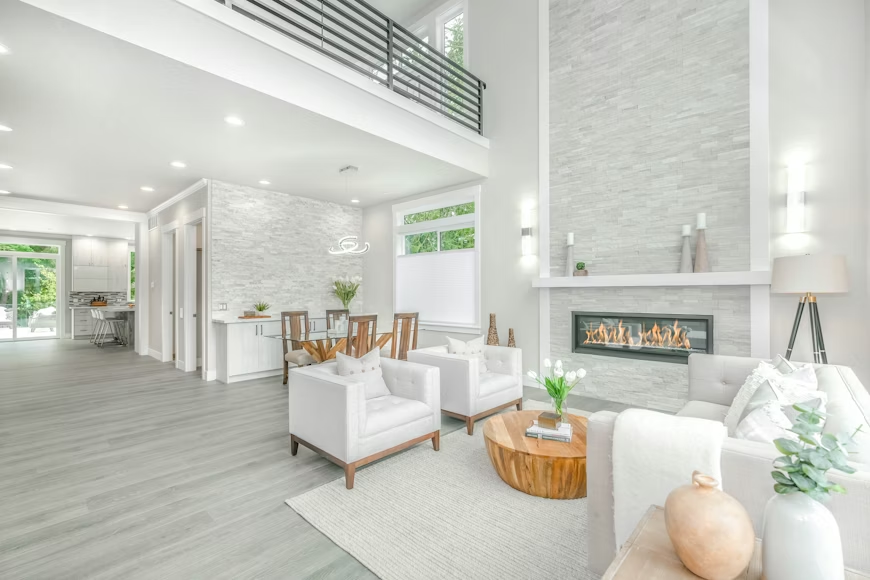
Long before a formal evaluation, a first impression-based analysis of comfort, quality, and suitability has already taken place. Even with zero knowledge of the space’s square footage or listing details, what catches your eye is the warm sun rays flooding the rooms and the open layout that makes the home feel light and free.
In an instant, you can imagine living comfortably within those walls that you haven’t yet deciphered in real numbers. Interior designers also value the effect of first impressions. Luxury residential interior designer, Karishma Trehan, shared in an interview that, “I look for potential first. The quiet possibilities a space holds long before the first sketch is drawn. That first impression becomes the foundation of my design process.”
Spaces are being read, not in a numerical but in a perceptual way. As per a 2024 eye-tracking study, visual attention patterns are strongly associated with later judgements of quality, layout, and spatial appeal. This means early visual instincts hold the power to change the outcome of a home evaluation.
When all is said and done, why is it this way? Visual instincts are based on certain cues that have little to do with measurements, as follows:
- Natural light and its distribution
- Spatial proportion and balance
- Color harmony
- A sense of openness versus visual compression
- Overall coherence at first glance
Maintenance as Evidence of Care
Before the renovation costs of a home come to light, its maintenance speaks volumes. Now, this act cannot be reduced to a clean numerical comparison. The most you can know, perhaps, is the age of construction, renovation history, or neighborhood ranking.
While such metrics do help to categorize the property, they often fail to capture the resistance power of the structure against the elements. Where else can this be particularly evident than in places where the climate has a lot of say in the materials and surfaces? Consider the example of a city like Edmonds in Washington, USA.
EA Pro Painters shares that although the coastal setting makes it appealing for families and businesses, the humidity of the place can do a number on painted surfaces. Historical weather data from 2025 showed recurring periods classified as ‘humid’ and ‘muggy’ within its seasonal comfort scale.
When thought practically, homes in regions like Edmonds must constantly negotiate with the moisture in the air. So, maintenance becomes a matter of ongoing preservation, not an occasional improvement. Of all things, painted exteriors are most at risk of damage.
The least that can become evidence of care in such circumstances is timely repainting done by an experienced painting company in Edmonds, right? This is also how maintenance makes home interiors personal at a conceptual level.
As the acclaimed American interior designer, Jeremiah Brent, shared, “When design is personalized, it’s timeless. Interiors are about your story, how you live, and what you love.” Viewed this way, maintenance is not exclusive of design. A personalized home is not created once and then left unchanged. It is constantly maintained and kept aligned with the life inside it.
Simple metrics tell you what a home is. Maintenance demonstrates what a home is becoming over time. On that note, here are some signs of maintenance as evidence of care:
- Fresh coats of paint and touched up corners, trims, and door frames
- Clean transitions between old and new elements
- No signs of buildup or neglect, even and especially in hard-to-reach areas like window frames and skirting boards
- The beauty of patina in the form of aged wood or stone surfaces that have lost their initial sharpness of texture
Continuity as a Determinant of Long-Term Comfort
This one is for the period after all the formal metrics have been seen, analyzed, and considered. No matter how prim and proper a home looks on paper, its true value can only be known after one has lived within its walls for some time.
Many of us are no strangers to that feeling of familiarity and warmth a space affords simply because it has become fully known. However, this feeling cannot be had at just any property.
Yes, it has to do with the interior design that can make or break a sense of belonging. Essentially, every home has a certain character, much like humans, one that requires time to get accustomed to. This explains why it is possible to find long-term comfort in a modest property and be restless in a luxurious one.
As per a 2024 study, the subjective evaluation of living conditions accounted for 6% of the variance in psychological well-being. The study evaluated five subjective home environment variables, including protection from disturbing nightlight, daylighting, safety, noise disturbances, and quality of window views. The last one is encouraged even in spaces other than one’s home.
This means even if the percentage is small, there is something called subjective evaluation of a space that affects long-term well-being as its resident. Continuity in a home reveals itself through the following:
- Whether comfort within its walls increases or fades with time
- Whether the space feels emotionally warm, neutral, or cold
- Whether small imperfections become a part of the home’s familiarity or inconveniences
- Whether moving through the rooms feels effortless or tedious
FAQs
Why are homes often judged using measurements and numbers?
Homes are commonly evaluated through simple metrics like price, square footage, or location ratings because these provide an easy way to compare properties. However, such numbers only describe the structural features of a home. They cannot capture the essence of its interiors, which is why two homes with similar metrics can feel completely different when lived in.
What role do first impressions and maintenance play in home evaluation?
Before any formal analysis takes place, visual instincts kick in and shape how a home is perceived. Elements like natural light, spatial balance, and overall coherence impact this instant judgment. Beyond that, maintenance adds another layer by revealing how a home is cared for over time. Details like surface repairs and natural patina point towards a home that is actively preserved.
Why does long-term experience of a home matter?
Ultimately, a home can only be understood through continuity rather than a single moment of evaluation. Over time, comfort and emotional safety within the space either develop naturally or fall apart. This means a home may not stand out at first glance and still become deeply comfortable later. It is this long-term experience that determines whether a space truly fits the life within it.
Recent Data on Home Perception
|
2024 eye-tracking study on visual attention patterns |
Found to be associated with later judgments about quality, layout, and spatial appeal |
|
2025 historical weather data of Edmonds, Washington |
Recurring periods classified as ‘humid’ and ‘muggy’ were found in its seasonal comfort scale |
|
Psychological well-being variance based on subjective evaluation of living conditions, as found in a 2024 study |
6% |
We all started from a place where homes were introduced to us through numbers, be it price tags or square footage. It’s only time and experience that taught us the profound truth of how these metrics are incomplete despite being useful.
After all, a home is seldom viewed as a fixed object. It is either a personal asset or a container that stores precious memories for life. Can numbers ever offer a complete picture of the stories the walls can tell?
Perhaps the question that needs to be asked is not, “What is this home worth?” It’s about time that numbers are treated for what they are, summaries, and not stories. In the end, there isn’t a single property that you will remember by a set of figures. So, make those abstract methods of evaluation your top priority even now.