
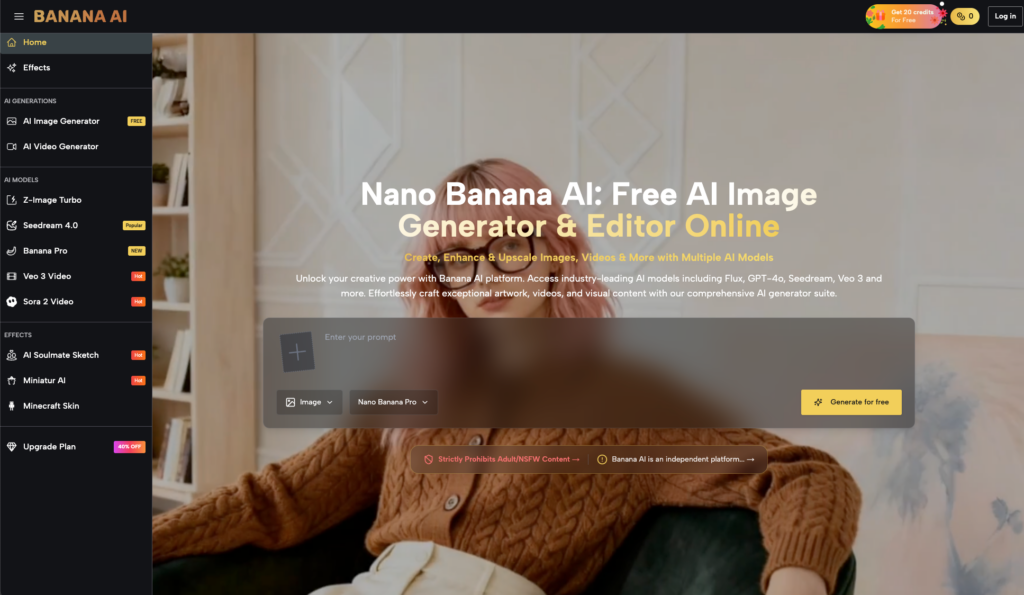
The core issue is that many teams treat tools like Banana AI as simple slot machines—pulling the lever with increasingly complex prompts, hoping for a jackpot. This approach ignores the technical nuances of latent space and the structural constraints required to make AI-generated visuals actually useful in a commercial context.
The Generative Speed Trap: When High Volume Becomes Noise
The primary fallacy in modern AI workflows is the belief that more generations lead to a better final product. In reality, excessive batching without established control parameters creates significant “selection fatigue.” When a creator generates 50 variations of a single concept, they aren’t just spending compute credits; they are investing significant cognitive energy into filtering, comparing, and critiquing.
In a professional production pipeline, this overhead often outweighs the time saved by the AI itself. If the variations lack a shared structural foundation, the creator is forced to choose the “least bad” option rather than the “correct” one. This is the difference between generative play and production-ready creation. High-speed workflows that prioritize volume over constraint almost always result in a collection of disparate images that look good individually but fail to function as a cohesive set.
Furthermore, the lack of constraint often leads to “hallucinated style drift.” Without a locked-in seed or a reference image, the AI interprets the “spirit” of the prompt differently with every iteration. This variability is fine for inspiration but detrimental for anyone trying to maintain a consistent visual identity across a website, a social campaign, or a product launch.
Engine Misalignment: Why Model Selection Trumps Prompt Length
A common mistake among prompt-first creators is trying to solve output issues with longer, more descriptive prompts. While prompt engineering has its place, it is often a secondary factor compared to model selection. Within a platform like Banana AI, different engines serve different operational goals.
For instance, utilizing a model like Z-Image Turbo is ideal for rapid prototyping. It is built for speed, allowing a creator to quickly map out compositions or color palettes. However, leaning on a “Turbo” model for final, high-fidelity branding often leads to frustration. These models are optimized for inference speed, which sometimes means they lack the nuance and anatomical precision found in more robust models like Seedream 4.0 or Banana Pro.
One significant limitation in current AI development is that a “fast” model is not simply a “faster version” of a “good” model; it is a fundamentally different architecture with different biases. If a team tries to force a speed-optimized model to produce high-detail, architecturally sound visuals through prompt hacking, they will likely spend more time troubleshooting than they would have by simply using a more capable, albeit slower, model from the start. Knowing when to transition from the rapid prototyping phase to the high-detail rendering phase is a critical skill for any operator.
The Style Drift Crisis in Unstructured Workflows
Visual consistency is the hallmark of professional design. In the context of Banana AI Image, style drift often occurs because users fail to anchor their generations to specific technical parameters. Even a slight change in aspect ratio—switching from a 16:9 cinematic view to a 1:1 square—can radically alter how the model weights certain parts of the prompt.
When a workflow is optimized solely for speed, users often ignore the “Seed” value. The seed is the numerical starting point for the noise that the AI “denoises” into an image. In an unstructured workflow, this seed is randomized every time. While randomness is great for variety, it is the primary cause of style drift.
If you are developing a series of characters or a product line, the lack of a consistent seed means the lighting, the texture of the materials, and even the “camera” angle will fluctuate. This is where “speed” becomes a liability. A team might generate 200 images in an hour, but if none of them share a consistent lighting logic because the seed was never managed, the hour is effectively wasted.
Operationalizing Control: Leveraging the Image-to-Image Pipeline
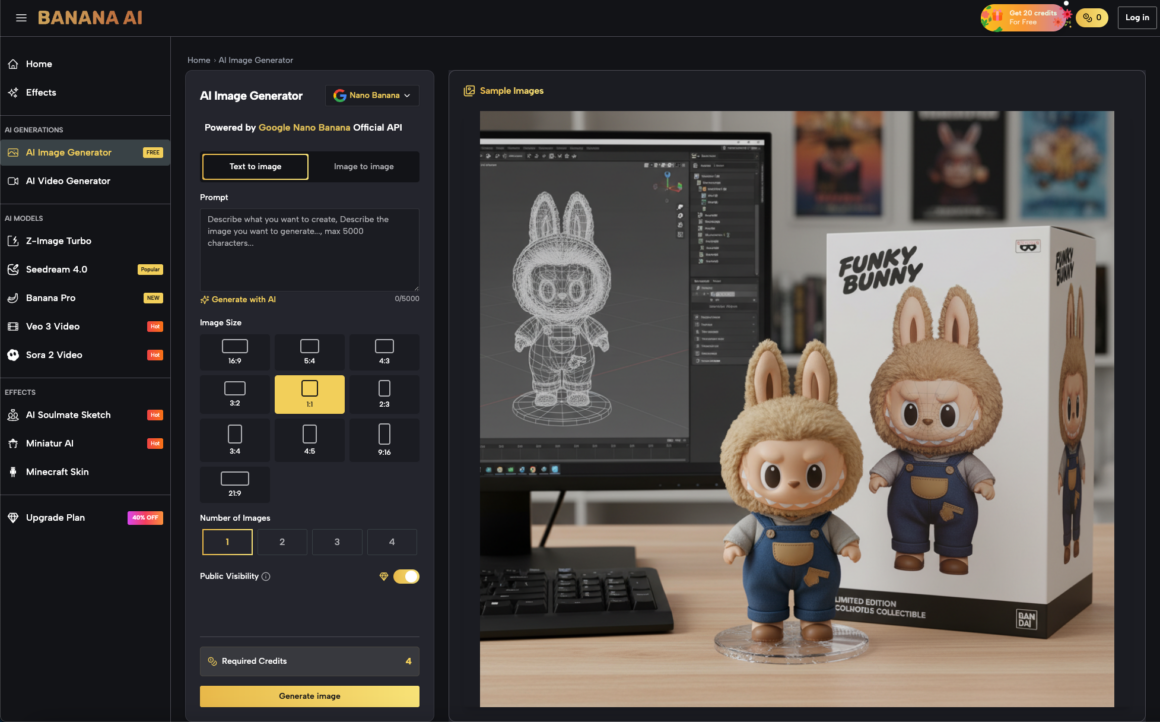
To solve the speed vs. control paradox, creators must move away from a purely text-to-image mindset. The most effective way to maintain brand geometry and visual coherence is through the image-to-image (img2img) pipeline.
Instead of asking the AI to “create a modern office in a minimalist style” repeatedly, a controlled workflow involves creating or selecting one “anchor” image that captures the desired composition and lighting. This approach is equally essential for stylistic transformations; for example, executing a flawless Photo to Caricature translation requires a source image to lock down facial geometry before the AI applies exaggerated artistic filters. By using an anchor in the Banana AI Image interface, the creator can then use text prompts to make incremental changes—swapping out furniture, changing the time of day, or adjusting stylistic intensity—while keeping the core structural perspective locked.
The use of specific models like Banana Pro within this pipeline further stabilizes the output. High-end models are generally better at adhering to the “influence” of a reference image, whereas faster, lower-parameter models might deviate wildly from the reference in an attempt to satisfy the text prompt. Transitioning to a workflow where the first 20% of the time is spent “locking” the visual parameters and the remaining 80% is spent on controlled variations is the only way to scale production without sacrificing quality.
The Limits of Control: Navigating AI Non-Determinism
It is vital to maintain a level of skepticism regarding how much “control” is actually possible. Even with a locked seed, a reference image, and a high-fidelity model, generative AI remains a non-deterministic technology. There is currently no way to guarantee 100% pixel-level placement or identical texture replication across different prompts.
This is a necessary expectation-reset for teams used to traditional CAD or vector-based design tools. In traditional design, a 5% change in a parameter yields a 5% change in the output. In AI, a 5% change in a prompt or a “denoising strength” slider can sometimes result in a 50% change in the final visual.
Because of this inherent unpredictability, no AI visual workflow can be fully automated without a human-in-the-loop for quality assurance. The “dream” of a one-click button that generates a perfect, brand-compliant campaign is still a technical impossibility. The goal of using tools like Banana AI should not be to replace the designer’s judgment, but to provide a more responsive canvas that requires even sharper editorial oversight.
Ultimately, the most successful creators are those who realize that “fast” is only useful when it is heading in the right direction. By prioritizing structural control over raw generation speed, teams can move past the experimental phase of AI and begin producing assets that meet the rigorous standards of professional branding and media production.



