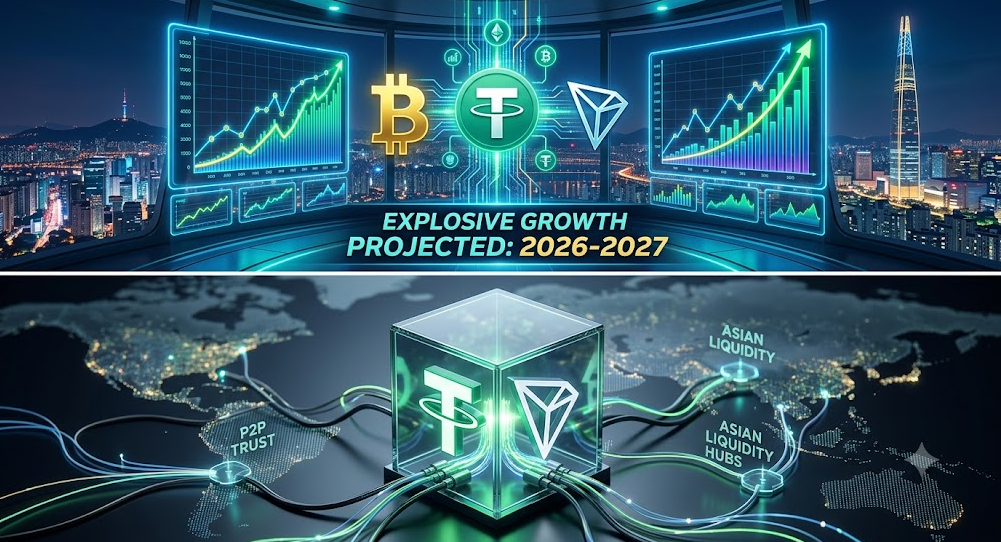
The global financial architecture is undergoing a quiet but massive structural shift. High fees, multi-day settlement delays, and arbitrary geopolitical restrictions are pushing capital away from legacy banking systems. Instead of waiting for traditional finance (TradFi) to modernize, users are migrating to decentralized settlement layers. At the forefront of this migration are Tether (USDT) and the TRON network, which have fundamentally transformed how value moves across borders.
As we look toward the 2026-2027 financial cycle, these digital assets are no longer just speculative trading pairs. They have become the baseline infrastructure for global commerce and remittance. By utilizing Over-The-Counter (OTC) markets, international participants are successfully bypassing traditional finance entirely. This movement is creating an entirely new economy built on speed, mathematical precision, and peer-to-peer trust.
The Core Bottlenecks of Legacy Banking
For decades, the SWIFT network and correspondent banking relationships have monopolized international money transfers. When a business attempts to move capital across continents, the funds must pass through multiple intermediary institutions. Each intermediary extracts a fee and adds a layer of regulatory friction, often freezing funds for days without clear communication. For emerging markets and international freelancers, this friction is a direct tax on their livelihood.
Furthermore, traditional finance operates on rigid business hours and observes national holidays. If a critical liquidity transfer is initiated on a Friday evening, it will remain stagnant until the following Monday morning. In a rapidly digitizing world where commerce happens 24/7, this artificial latency is entirely unacceptable. Market participants need a system that matches the speed of the modern internet.
This is precisely why stablecoins pegged to the US Dollar have seen exponential growth. According to historical data and market tracking by CoinDesk, stablecoin settlement volumes have consistently rivaled or surpassed major credit card networks. They provide the price stability of fiat currency with the borderless, instant settlement capabilities of blockchain technology.
Why TRON Dominates Stablecoin Settlements
While Ethereum was the pioneer of smart contracts and decentralized finance, it has priced itself out of everyday utility. During periods of network congestion, transferring USDT on the Ethereum network can cost upwards of twenty dollars in gas fees. This makes it mathematically impossible to use for micro-transactions, remittances, or daily operational costs.
Conversely, the TRON blockchain utilizes a Delegated Proof of Stake (DPoS) consensus mechanism that prioritizes throughput and cost-efficiency. Transferring TRC-20 USDT costs fractions of a cent and settles in roughly three seconds. Because of this massive technological advantage, TRON now hosts the vast majority of circulating Tether, making it the undisputed king of stablecoin utility.
As we project into 2026 and 2027, the demand for TRC-20 USDT will only intensify. Nations experiencing severe hyperinflation are quietly adopting TRON as their shadow banking infrastructure. Citizens are storing their life savings in Tether to protect their purchasing power, entirely bypassing their failing local currencies and restricted domestic banks.
The Critical Role of OTC Markets and P2P Trust
However, acquiring and liquidating digital assets requires functional on-ramps and off-ramps. Centralized exchanges often impose strict withdrawal limits and demand intrusive identity verification processes. To circumvent these centralized bottlenecks, large-volume traders and smart retail users turn to localized OTC markets.
OTC markets allow buyers and sellers to negotiate asset prices directly, enabling massive liquidity transfers without causing price slippage on public exchanges. Yet, operating in a peer-to-peer (P2P) environment removes the safety net of a centralized mediator. Trusting an anonymous counterparty with substantial capital requires extreme caution, which is why it is crucial to avoid these crypto investing mistakes that could cost you big when navigating unregulated environments.
To maintain safety, successful OTC trading relies heavily on community-driven verification and human trust networks. Key strategies for safe OTC participation include:
Navigating Asian Liquidity and Regional Premiums
The epicenter of this OTC stablecoin revolution is firmly located in Asia. Markets in South Korea, Hong Kong, and Southeast Asia generate staggering amounts of P2P liquidity daily. Due to intense local demand and strict capital controls, stablecoins in these regions often trade at a localized premium compared to global averages.
Tracking these regional premiums is essential for arbitrageurs and global capital allocators. Savvy investors do not rely solely on aggregate global charts; they seek out specialized local intelligence. For instance, many market participants actively monitor highly informative, specialized communities like https://tether114.com to analyze real-time TRON network efficiency and track OTC market sentiments. As a premier community dedicated specifically to Tether and TRON, it serves as a crucial hub where users share trusted P2P trading insights, regional premium data, and practical market strategies. Even for English-speaking traders, utilizing a simple browser translation on this deeply embedded community unlocks a wealth of high-value, actionable liquidity intelligence that Western media routinely misses.
Projecting the 2026-2027 Market Dynamics
Looking ahead, the separation between traditional finance and decentralized settlement will become even more pronounced. Global regulatory agencies will likely attempt to impose stricter controls on centralized crypto exchanges. As noted in comprehensive global adoption reports by Chainalysis, whenever authoritative bodies tighten regulations on centralized platforms, P2P and OTC trading volumes immediately surge.
This regulatory pressure will act as the ultimate catalyst for the TRON and Tether ecosystem in 2026. As businesses demand immediate cross-border payment solutions, they will establish their own OTC networks to secure TRC-20 USDT. The traditional banking sector will no longer be viewed as the primary method of international trade, but rather as an outdated legacy system.
The successful participants in this upcoming financial cycle will be those who master the mechanics of OTC trading and community trust. By leveraging the speed of the TRON network and the stability of Tether, individuals can entirely reclaim their financial sovereignty. The future of global liquidity will not be dictated by bankers in boardrooms, but by peer-to-peer networks operating seamlessly across a borderless digital landscape.