
Gamified education has been one of the most exciting pedagogic trends available since it first emerged in the mid-2000s. The concept was initially designed for classrooms and has since expanded into other territories, including online courses and corporate training.
The pedagogic merits of the gamified approach have long been documented, with a study published in the Frontiers journal concluding that “gamification may hold promise as a viable approach for promoting teaching and learning in diverse educational contexts”. However, the same research has shown that the effectiveness of gamified education is intrinsically related to how the method is specifically applied.
As the central thesis of gamified education is to use game mechanics and reward systems to maximize student engagement, investigators have traditionally focused on diagnosing the games first (everything from poker to video games) and only later extrapolated what they have learned to the classroom or training ground.
This article focuses specifically on a new type of games’ platform that has been growing in popularity, particularly in the United States: sweepstakes casinos. How can this new gaming experience inform educators, and what lessons have we learned from studying these platforms?
Validating Failure via Dual-Currency Systems
Sweepstakes casinos operate in the United States by allowing users to play chance games using virtual tokens. What’s new about their model is that tokens are divided into two types: Sweep Coins, used to play “for real” and access rewards, and Fun Coins, used to play “just for fun”.
|
Sweepstakes casinos |
Traditional online casinos |
|
Users make deposits to buy virtual tokens |
Users make deposits that are directly used to bet on games |
|
Users bet on games using virtual tokens |
|
|
Users can play using two types of currency |
Only one type of currency is available |
The dual-currency system maximizes engagement on sweepstakes casinos because it allows players to use risk-free currency (Fun Coins) to learn more about the games before risking losing high-stakes currency (Sweep Coins). Failure is not only a part of the process, but it’s also highly encouraged.
From a pedagogic standpoint, the ability to choose between playing “for real” and “just for fun” sets students free by validating failure and, therefore, maximizing engagement. If students aren’t afraid to fail, they will be more open to experimentation and take a more active role during learning. Moreover, the ability to choose when to play for real or not can improve decision-making and reinforce the students’ sense of responsibility.
Live Visualization of Micro Rewards
Micro rewards are probably the most decisive engagement factor in sweepstakes casinos, as frequent wins in fast-paced games, such as slots and live tables, are what motivates users to keep on playing. Non-gamified education ignores this idea by focusing on a limited set of long-term rewards (for example, passing a final exam).
Research shows that “long-term trajectories” (i.e., gamified education programs lasting six months or more) “are effective because they help students develop intrinsic motivation over time”, but that doesn’t mean rewards should be long-term as well.
The appeal of micro rewards in sweepstakes casinos proves that engagement can be improved when students are given frequent reminders of their own progress. Motivation is a decisive factor for engagement, and objective day-by-day appreciation can drastically increase it.
This idea gets even more interesting when one considers that sweepstakes casinos further enforce the presence of micro rewards with live visualization tables that show the activity of other users, including their collected rewards.
This Sweepcoins.com screenshot shows, minute by minute, exactly how much other users have bet and exactly how much they have won:
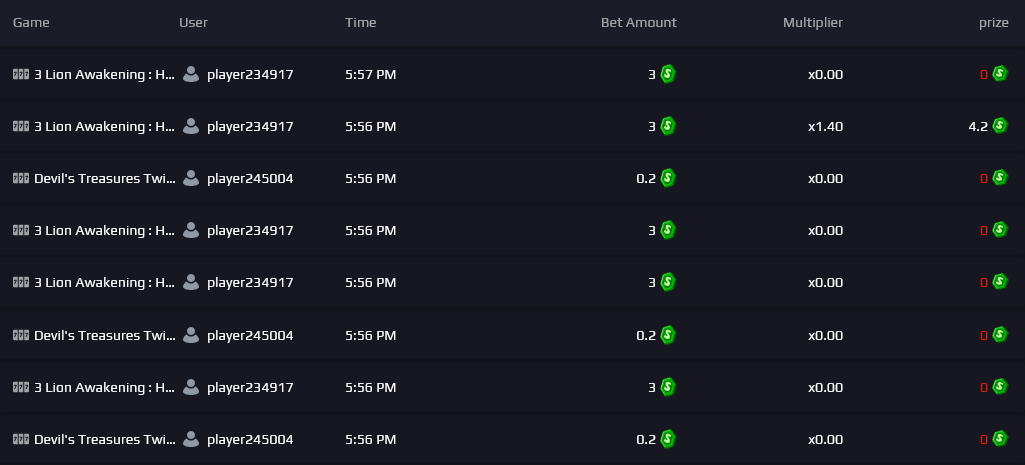
The live table is a strong engagement incentive because it fosters a sense of community, exposing the “learning” difficulties and day-by-day rewards that are also experienced by others.
Other Interesting Ideas
There are further sweepstakes casino ideas that can have beneficial gamified education applications. The regular use of user-level rankings, based on player activity, can have a similar effect to micro rewards, reminding students, on a short-term basis, of their small but objective day-to-day progress.
Bankroll management is another key element of sweepstakes casino logic that can have pedagogic applications. Concentration levels can improve if students are working with a scarce range of options (such as a limited number of Coins to play with).
Where to Go From Here?
While educators can learn a lot from the way in which sweepstakes casinos drive engagement, gamified education methods can only be proven effective when applied to real classrooms, training programs, and digital courses.
According to a comprehensive PMC study on gamified education, “it is recommended to focus on feedback, challenge, and concentration elements” in order to “optimize the gamification design”. In other words, gamified education hypotheses must:
These pedagogic ideas are aimed at educators, but they can be applied outside official learning environments, offering generic valuable lessons on how to maximize engagement.