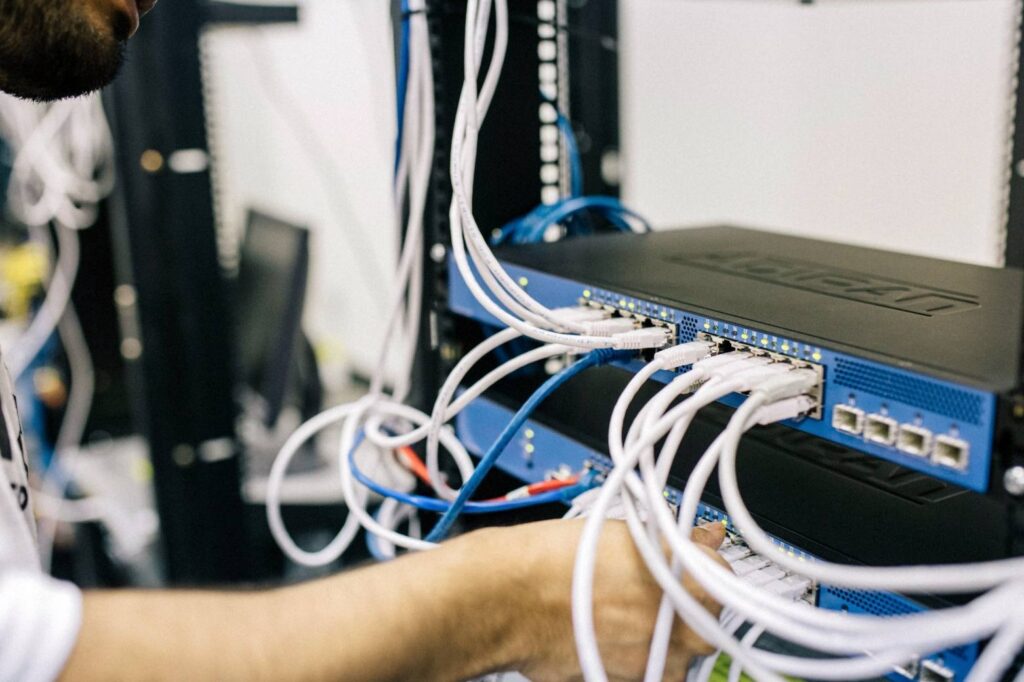
Financial markets will never be forecastable (though people will always try), but trading systems must be. What matters is a system that stays reliable in chaos: executing quickly, managing risk wisely, and holding to a strategy when the market tries to shake it apart.
Thriving in Volatile and Always-On Financial Markets
Modern financial markets operate at a pace that renders human decision-making obsolete for certain strategies. Algorithmic trading uses software to execute trades based on predefined rules, from fundamental analysis to quantitative models, operating across varied timeframes. High-frequency trading (HFT) is a specialized subset, defined by extreme speed and a focus on exploiting fleeting market microstructure inefficiencies rather than long-term value.
While all HFT is algorithmic, most algorithmic trading is not HFT. The distinction matters because HFT pushes engineering challenges to their absolute limits.
The market is fragmented across exchanges, ECNs, and dark pools, each with distinct rules and latency. In this digital battlefield, the order book, the real-time ledger of buy and sell orders, is the primary data source. Algorithms react to every change with minimal delay. The bid-ask spread is a direct profit source for market-makers, not just a transaction cost.
Predictability as the Real Advantage in Fast Markets
In HFT, performance is measured in nanoseconds. The key metric is tick-to-trade latency, the total time from receiving market data to sending a trade order. This covers every step: network IO, processing, calculation, risk checks, and transmission.
For years, the mandate was simple: be faster than the competition. This drove investment in speed, pushing latency down to nanoseconds. Latency arbitrage, which exploits tiny price discrepancies, is a winner-take-all game. For example, when an S&P 500 ETF moves, the related futures contract follows instantaneously. The first actor to detect the move and trade the other instrument captures the profit. The second participant gets nothing.
As firms neared physical limits, the goal evolved. Determinism, the consistency of system delay, became as important as speed. A system that is fast on average but suffers unpredictable slowdowns is unreliable.
The industry mantra shifted: determinism is the new latency.
A deterministic system delivers repeatable performance, free from high-latency outliers. Since trading venues must process orders sequentially, non-deterministic internal systems are a liability. Many strategies require simultaneous order placement across separate venues within precise time windows to prevent arbitrage. Here, delay consistency becomes more important than the absolute minimum.
Predictable systems also enable better risk management.
Foundations of Reliable, Low-Latency Trading Systems
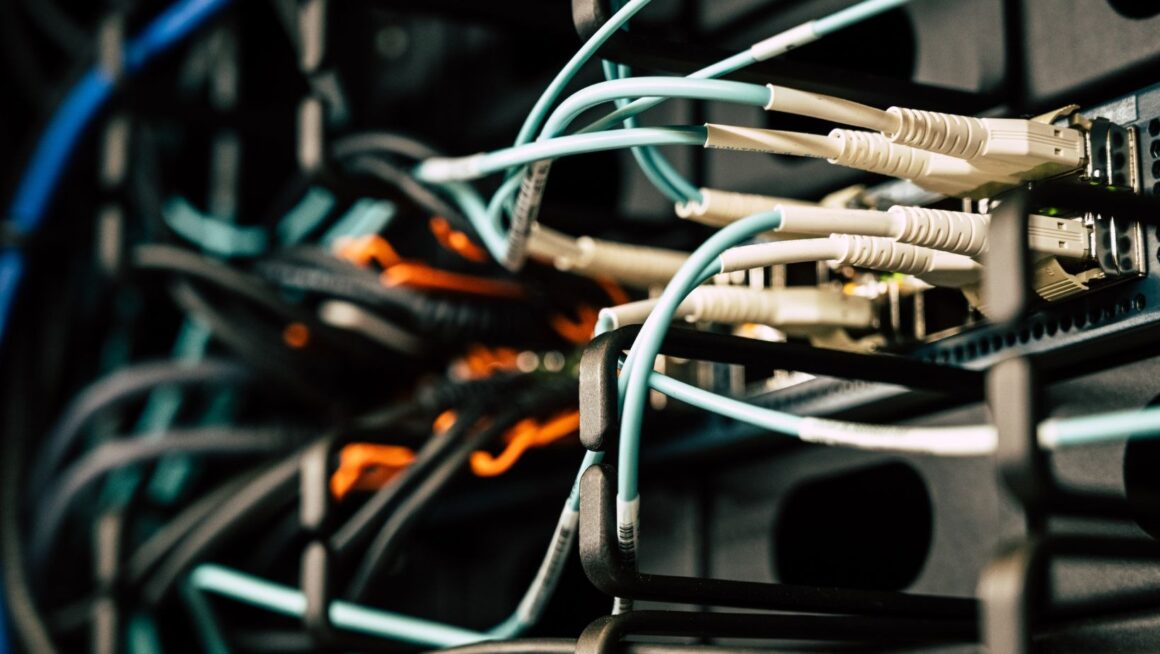
Building a predictable HFT system requires viewing the entire process as a single, integrated, real-time data pipeline. Every component is a potential source of latency and non-determinism. The pipeline moves through distinct stages:
- Market data ingestion — Connects directly to exchange data feeds transmitting every market event in real time. The challenge is receiving and normalizing these massive streams with minimal latency.
- Strategy execution — Houses the alpha-generating algorithm that processes data and makes trade decisions. Advanced systems implement this logic in FPGA hardware for the lowest decision latency.
- Order management — Handles the trade order lifecycle from creation through possible modifications to a successful trade or a cancelation. HFT-grade systems must handle thousands of state changes per second deterministically.
- Real-time risk engine — Acts as the system’s guardian. Before an order enters the market, it must pass pre-trade risk checks against firm-wide limits (position size, capital exposure, etc.) to prevent catastrophic errors.
- Execution gateway — The final outbound component, formatting orders into exchange-specific protocols and transmitting them.
A critical principle is in-line risk management integration. The risk engine sits directly in the tick-to-trade “hot path.” Every order must pass its checks, meaning any risk engine latency directly degrades competitiveness. This forces equal investment in ultra-low-latency risk technology and in primary trading strategies.
Hardware Choices That Shape Performance Outcomes
The quest for predictable, low-latency performance begins at the hardware layer, where HFT firms exploit physics to gain an advantage. This “physical arbitrage” takes three primary forms.
First, co-location involves renting rack space in the same data center as the exchange’s matching engine. This minimizes physical distance, ensuring the shortest possible fiber optic cables and reducing transmission delays to their absolute minimum.
Second, for connecting different financial centers, firms use private microwave and laser networks. Since light travels ~31% faster through air than through fiber optic glass, these networks offer more direct, faster paths than traditional buried fiber.
Third, at the silicon level, general-purpose CPUs are avoided for critical tasks. Their reliance on operating systems and caches introduces unpredictable delays, or “jitter”. The solution is Field-programmable gate arrays (FPGAs), circuits where logic is programmed directly into the hardware. FPGAs offer two key advantages:
- Massive parallelism: They can execute dozens of simple tasks simultaneously without competing for resources.
- Extreme determinism: Logic etched in silicon creates fixed, nanosecond-predictable execution times, free from OS schedulers or interrupts.
FPGAs are used as hardware accelerators for the most latency-sensitive tasks: market data handling, risk checks, and order execution. This creates powerful hybrid systems, freeing CPUs for higher-level strategy calculations while combining deterministic hardware speed with software flexibility. Firms like Magmio (www.magmio.com) integrate these FPGA stages with software APIs, allowing firms to customize strategies without deep hardware expertise.
Summary
In High-frequency trading, the engineering goal has evolved from raw speed to determinism: consistent, predictable system performance. This is achieved through “physical arbitrage” like co-location and microwave networks, and critically, by using FPGAs (Field-Programmable Gate Arrays) instead of CPUs for core tasks. FPGAs provide fixed, nanosecond-predictable execution times. This deterministic design extends to safety, integrating robust, in-line risk controls directly into the hardware, ensuring that performance and safety are inextricably coupled.