

The current state of performance marketing is defined by a paradox: platforms like TikTok and Meta have never been better at finding an audience, but they have also never been more hungry for fresh creative. For internal teams and agencies, the “hero asset” model—where a single high-production video or image carries a campaign for three months—is effectively dead. For brands that need a consistent content and ad creative pipeline, social media marketing packages can help organize strategy, posting, creative production, and campaign support into a more scalable system.
To stay competitive, creative operations are shifting away from monolithic production toward modular, AI-integrated workflows. The goal is no longer to find one “perfect” prompt that generates a finished ad, but to build a pipeline where different models handle specific tasks. By utilizing specialized tools like Nano Banana Pro for speed and higher-fidelity models for core assets, teams can maintain a high volume of output without sacrificing the brand’s visual integrity.
The Production Debt of Modern Performance Marketing
Performance marketing teams are currently facing a “production debt.” This occurs when the speed at which an algorithm fatigues a creative asset outpaces the speed at which a design team can produce a replacement. When an ad’s frequency climbs and its click-through rate (CTR) plateaus, the standard response is to swap the creative. However, if the design team is tethered to traditional stock photo manipulation or slow internal feedback loops, they cannot keep up.
The hidden cost of this lag isn’t just wasted ad spend; it’s the erosion of creative standards. When designers are under pressure to deliver fifty variations by Friday, they tend to take fewer risks. They lean on “safe” compositions and generic layouts. This leads to what many call “platform blindness,” where users subconsciously tune out ads because they look exactly like every other sponsored post in their feed.
Breaking this cycle requires a move away from manual asset generation. The focus must shift from “making the asset” to “orchestrating the system that makes the asset.” This is where a multi-model approach, utilizing specialized Banana AI workflows, becomes a tactical necessity rather than a luxury.
Banana Pro AI: Speed as a Creative Catalyst
In a professional creative environment, speed is often more valuable than raw resolution—at least in the early stages of a project. This is where Nano Banana Pro fits into the modern stack. Most generative AI models are computationally heavy, leading to latencies that can disrupt a designer’s “flow state.” If a creator has to wait 30 to 60 seconds to see if a prompt concept works, the cost of experimentation becomes too high.
Nano Banana Pro is designed for lower-latency generation. While it may not always produce the final, 4K-ready hero image on the first click, its value lies in its role as a “digital sketching” tool. It allows a marketer or designer to cycle through twenty different lighting setups, camera angles, or color palettes in the time it would take a larger model to produce one.
This speed-first approach is critical for social media iteration. For instance, if a team needs to test whether a “lo-fi” aesthetic performs better than a “cinematic” one for a specific demographic, they can use Nano Banana to generate both directions in seconds. It allows for rapid ideation before the team commits to the high-fidelity rendering phase.
Architecting the Modular Asset Pipeline
A mature AI production pipeline doesn’t rely on a single model. It treats different generative engines like specialized members of a crew. In a standard workflow for a landing page or social campaign, the division of labor often looks like this:
First, Banana Pro is used to create the “Anchor Assets.” These are the high-fidelity, brand-critical images—perhaps a central character, a primary product shot, or a complex hero background. These require the deep detail and composition control that larger models provide. Once the anchor is established, the team has a visual North Star.
Next, Nano Banana is employed to create the “Peripheral Assets.” This includes environment variations, seasonal swaps (adding snow for a winter sale or autumn leaves for October), and lighting shifts for different social platforms. Because these assets are often blurred or serve as backgrounds for text overlays, the extreme speed of the Nano model is a massive force multiplier.
The final layer involves structuring prompts to maintain stylistic consistency. A common pitfall is using wildly different prompt structures for different models, which leads to a fragmented brand look. Successful teams use “style seeds” or consistent descriptor blocks across both Nano Banana Pro and the flagship models to ensure that even though the models are different, the visual language remains unified.
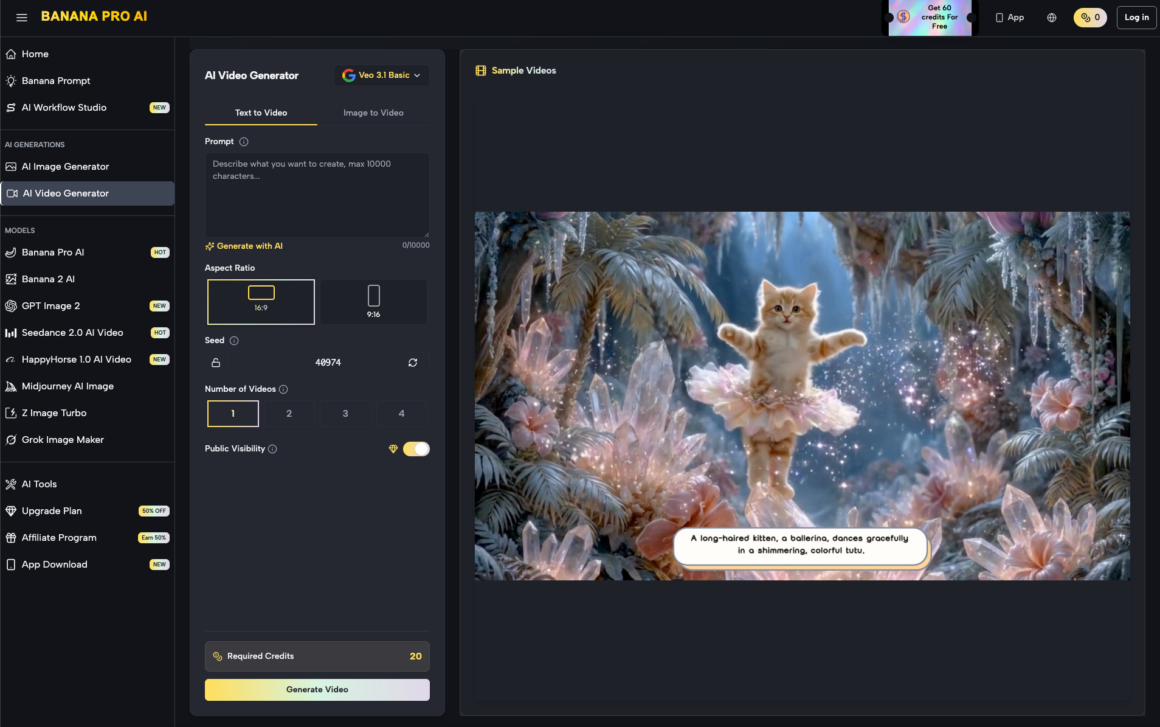
Refining the Output: The Role of the AI Image Editor
One of the most significant misconceptions in AI-assisted design is the “one-shot” myth. Professionals know that a raw output from a generative model is rarely ready for a Meta Ads Manager upload. There are almost always issues with spatial consistency, text-safe zones, or regional localization requirements.
This is where the AI Image Editor becomes the bridge between a generative concept and a deliverable asset. A canvas-based workflow is essential here. Instead of just “prompting and praying,” designers need to be able to move elements around, expand backgrounds to fit different aspect ratios (like moving from a 1:1 Instagram post to a 9:16 Story), and clean up artifacts.
For example, a marketing team might generate a high-quality product environment but realize the primary light source is blocking the area where the “Shop Now” button needs to sit. Using a dedicated editor allows for targeted in-painting or adjustment without regenerating the entire image and losing the parts that actually worked. This level of control is what separates hobbyist creators from production-ready operators.
Where the Workflow Fails: Explicit Boundaries of Current Tech
It is important to acknowledge that generative AI is not a total replacement for a creative department. There are specific technical limitations that every operator should account for to avoid “uncanny valley” results that can hurt brand trust.
First, typographic rendering within generative images is still hit-or-miss. While some models are improving, you should not rely on an AI model to generate perfect, brand-compliant copy inside an image. It is almost always better to generate the visual asset and then layer the text using professional design software. Expecting an AI to handle a specific brand font perfectly is a recipe for frustration.
Second, there is an inherent uncertainty regarding specific physical laws in complex generations. Fingers, certain types of reflections, and complex mechanical parts can still hallucinate in ways that are subtle enough to miss at a glance but obvious to a customer. We have found that while Banana Pro handles these better than most, human oversight is still the final gatekeeper. If an asset looks “off” but you can’t quite place why, it’s usually an anatomy or perspective error that requires manual correction in the editor.
Calculating the ROI of Generative Production Cycles
Transitioning to an AI-first modular pipeline is a strategic shift that requires buy-in from stakeholders who may be skeptical of “AI-generated” content. The most effective way to pitch this shift is through the lens of cost-per-variation.
In a traditional model, creating 50 variations of an ad might cost $5,000 in labor and stock assets. With a modular workflow using Nano Banana and the core Banana AI tools, that cost can drop significantly, while the volume of testing increases. This doesn’t mean you fire the creative team; it means the creative team now has the bandwidth to test five different hooks instead of one.
The real ROI isn’t just in saving money; it’s in the engagement lift. When you can tailor an ad’s background to a specific city, or change a character’s outfit to match a current trend in under five minutes, your relevance increases.
Building a sustainable tech stack means moving away from “prompt hacking” and toward a repeatable, modular system. By balancing the high-fidelity output of Banana Pro with the rapid-response speed of Nano Banana Pro, teams can finally stop running on the creative treadmill and start building an engine that scales.



